 Add to Chrome
 Add to Firefox
 Add to Edge
Adaptive 1D Video Diffusion Autoencoder
Feb 04, 2026
Recent video generation models largely rely on video autoencoders that compress pixel-space videos into latent representations. However, existing video autoencoders suffer from three major limitations: (1) fixed-rate compression that wastes tokens on simple videos, (2) inflexible CNN architectures that prevent variable-length latent modeling, and (3) deterministic decoders that struggle to recover appropriate details from compressed latents. To address these issues, we propose One-Dimensional Diffusion Video Autoencoder (One-DVA), a transformer-based framework for adaptive 1D encoding and diffusion-based decoding. The encoder employs query-based vision transformers to extract spatiotemporal features and produce latent representations, while a variable-length dropout mechanism dynamically adjusts the latent length. The decoder is a pixel-space diffusion transformer that reconstructs videos with the latents as input conditions. With a two-stage training strategy, One-DVA achieves performance comparable to 3D-CNN VAEs on reconstruction metrics at identical compression ratios. More importantly, it supports adaptive compression and thus can achieve higher compression ratios. To better support downstream latent generation, we further regularize the One-DVA latent distribution for generative modeling and fine-tune its decoder to mitigate artifacts caused by the generation process.

LongVie 2: Multimodal Controllable Ultra-Long Video World Model
Dec 15, 2025Building video world models upon pretrained video generation systems represents an important yet challenging step toward general spatiotemporal intelligence. A world model should possess three essential properties: controllability, long-term visual quality, and temporal consistency. To this end, we take a progressive approach-first enhancing controllability and then extending toward long-term, high-quality generation. We present LongVie 2, an end-to-end autoregressive framework trained in three stages: (1) Multi-modal guidance, which integrates dense and sparse control signals to provide implicit world-level supervision and improve controllability; (2) Degradation-aware training on the input frame, bridging the gap between training and long-term inference to maintain high visual quality; and (3) History-context guidance, which aligns contextual information across adjacent clips to ensure temporal consistency. We further introduce LongVGenBench, a comprehensive benchmark comprising 100 high-resolution one-minute videos covering diverse real-world and synthetic environments. Extensive experiments demonstrate that LongVie 2 achieves state-of-the-art performance in long-range controllability, temporal coherence, and visual fidelity, and supports continuous video generation lasting up to five minutes, marking a significant step toward unified video world modeling.
SJD++: Improved Speculative Jacobi Decoding for Training-free Acceleration of Discrete Auto-regressive Text-to-Image Generation
Dec 08, 2025Large autoregressive models can generate high-quality, high-resolution images but suffer from slow generation speed, because these models require hundreds to thousands of sequential forward passes for next-token prediction during inference. To accelerate autoregressive text-to-image generation, we propose Speculative Jacobi Decoding++ (SJD++), a training-free probabilistic parallel decoding algorithm. Unlike traditional next-token prediction, SJD++ performs multi-token prediction in each forward pass, drastically reducing generation steps. Specifically, it integrates the iterative multi-token prediction mechanism from Jacobi decoding, with the probabilistic drafting-and-verification mechanism from speculative sampling. More importantly, for further acceleration, SJD++ reuses high-confidence draft tokens after each verification phase instead of resampling them all. We conduct extensive experiments on several representative autoregressive text-to-image generation models and demonstrate that SJD++ achieves $2\times$ to $3\times$ inference latency reduction and $2\times$ to $7\times$ step compression, while preserving visual quality with no observable degradation.
The Quest for Generalizable Motion Generation: Data, Model, and Evaluation
Oct 30, 2025Despite recent advances in 3D human motion generation (MoGen) on standard benchmarks, existing models still face a fundamental bottleneck in their generalization capability. In contrast, adjacent generative fields, most notably video generation (ViGen), have demonstrated remarkable generalization in modeling human behaviors, highlighting transferable insights that MoGen can leverage. Motivated by this observation, we present a comprehensive framework that systematically transfers knowledge from ViGen to MoGen across three key pillars: data, modeling, and evaluation. First, we introduce ViMoGen-228K, a large-scale dataset comprising 228,000 high-quality motion samples that integrates high-fidelity optical MoCap data with semantically annotated motions from web videos and synthesized samples generated by state-of-the-art ViGen models. The dataset includes both text-motion pairs and text-video-motion triplets, substantially expanding semantic diversity. Second, we propose ViMoGen, a flow-matching-based diffusion transformer that unifies priors from MoCap data and ViGen models through gated multimodal conditioning. To enhance efficiency, we further develop ViMoGen-light, a distilled variant that eliminates video generation dependencies while preserving strong generalization. Finally, we present MBench, a hierarchical benchmark designed for fine-grained evaluation across motion quality, prompt fidelity, and generalization ability. Extensive experiments show that our framework significantly outperforms existing approaches in both automatic and human evaluations. The code, data, and benchmark will be made publicly available.
T2I-ReasonBench: Benchmarking Reasoning-Informed Text-to-Image Generation
Aug 24, 2025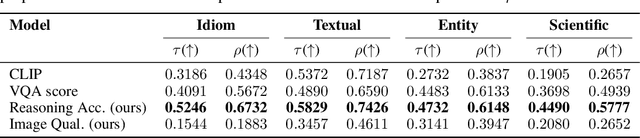
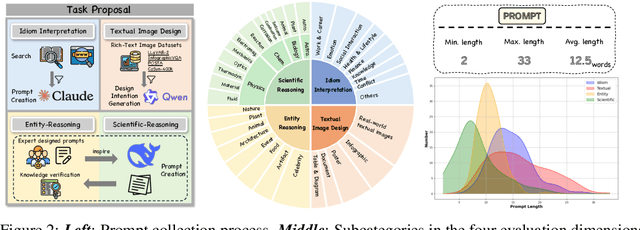
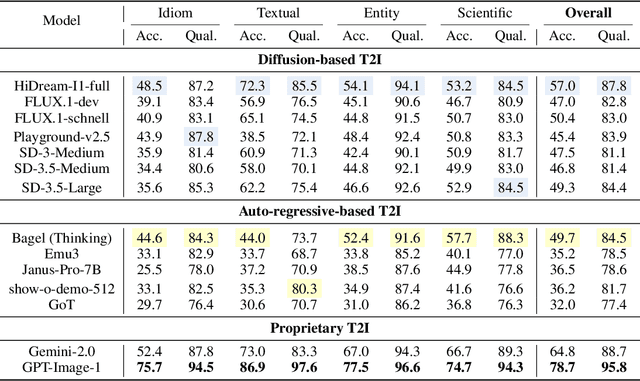
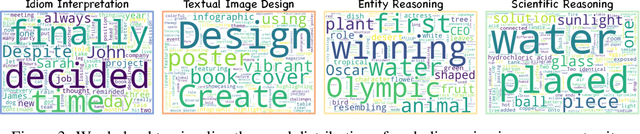
We propose T2I-ReasonBench, a benchmark evaluating reasoning capabilities of text-to-image (T2I) models. It consists of four dimensions: Idiom Interpretation, Textual Image Design, Entity-Reasoning and Scientific-Reasoning. We propose a two-stage evaluation protocol to assess the reasoning accuracy and image quality. We benchmark various T2I generation models, and provide comprehensive analysis on their performances.
DPoser-X: Diffusion Model as Robust 3D Whole-body Human Pose Prior
Aug 01, 2025We present DPoser-X, a diffusion-based prior model for 3D whole-body human poses. Building a versatile and robust full-body human pose prior remains challenging due to the inherent complexity of articulated human poses and the scarcity of high-quality whole-body pose datasets. To address these limitations, we introduce a Diffusion model as body Pose prior (DPoser) and extend it to DPoser-X for expressive whole-body human pose modeling. Our approach unifies various pose-centric tasks as inverse problems, solving them through variational diffusion sampling. To enhance performance on downstream applications, we introduce a novel truncated timestep scheduling method specifically designed for pose data characteristics. We also propose a masked training mechanism that effectively combines whole-body and part-specific datasets, enabling our model to capture interdependencies between body parts while avoiding overfitting to specific actions. Extensive experiments demonstrate DPoser-X's robustness and versatility across multiple benchmarks for body, hand, face, and full-body pose modeling. Our model consistently outperforms state-of-the-art alternatives, establishing a new benchmark for whole-body human pose prior modeling.
"PhyWorldBench": A Comprehensive Evaluation of Physical Realism in Text-to-Video Models
Jul 17, 2025Video generation models have achieved remarkable progress in creating high-quality, photorealistic content. However, their ability to accurately simulate physical phenomena remains a critical and unresolved challenge. This paper presents PhyWorldBench, a comprehensive benchmark designed to evaluate video generation models based on their adherence to the laws of physics. The benchmark covers multiple levels of physical phenomena, ranging from fundamental principles like object motion and energy conservation to more complex scenarios involving rigid body interactions and human or animal motion. Additionally, we introduce a novel ""Anti-Physics"" category, where prompts intentionally violate real-world physics, enabling the assessment of whether models can follow such instructions while maintaining logical consistency. Besides large-scale human evaluation, we also design a simple yet effective method that could utilize current MLLM to evaluate the physics realism in a zero-shot fashion. We evaluate 12 state-of-the-art text-to-video generation models, including five open-source and five proprietary models, with a detailed comparison and analysis. we identify pivotal challenges models face in adhering to real-world physics. Through systematic testing of their outputs across 1,050 curated prompts-spanning fundamental, composite, and anti-physics scenarios-we identify pivotal challenges these models face in adhering to real-world physics. We then rigorously examine their performance on diverse physical phenomena with varying prompt types, deriving targeted recommendations for crafting prompts that enhance fidelity to physical principles.
HMAR: Efficient Hierarchical Masked Auto-Regressive Image Generation
Jun 04, 2025Visual Auto-Regressive modeling (VAR) has shown promise in bridging the speed and quality gap between autoregressive image models and diffusion models. VAR reformulates autoregressive modeling by decomposing an image into successive resolution scales. During inference, an image is generated by predicting all the tokens in the next (higher-resolution) scale, conditioned on all tokens in all previous (lower-resolution) scales. However, this formulation suffers from reduced image quality due to the parallel generation of all tokens in a resolution scale; has sequence lengths scaling superlinearly in image resolution; and requires retraining to change the sampling schedule. We introduce Hierarchical Masked Auto-Regressive modeling (HMAR), a new image generation algorithm that alleviates these issues using next-scale prediction and masked prediction to generate high-quality images with fast sampling. HMAR reformulates next-scale prediction as a Markovian process, wherein the prediction of each resolution scale is conditioned only on tokens in its immediate predecessor instead of the tokens in all predecessor resolutions. When predicting a resolution scale, HMAR uses a controllable multi-step masked generation procedure to generate a subset of the tokens in each step. On ImageNet 256x256 and 512x512 benchmarks, HMAR models match or outperform parameter-matched VAR, diffusion, and autoregressive baselines. We develop efficient IO-aware block-sparse attention kernels that allow HMAR to achieve faster training and inference times over VAR by over 2.5x and 1.75x respectively, as well as over 3x lower inference memory footprint. Finally, HMAR yields additional flexibility over VAR; its sampling schedule can be changed without further training, and it can be applied to image editing tasks in a zero-shot manner.
The Dance of Atoms-De Novo Protein Design with Diffusion Model
Apr 23, 2025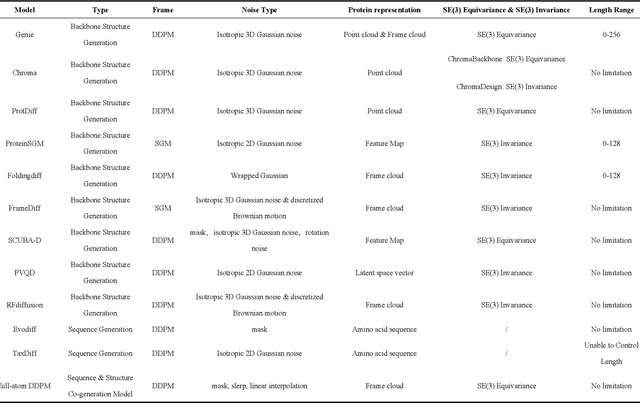
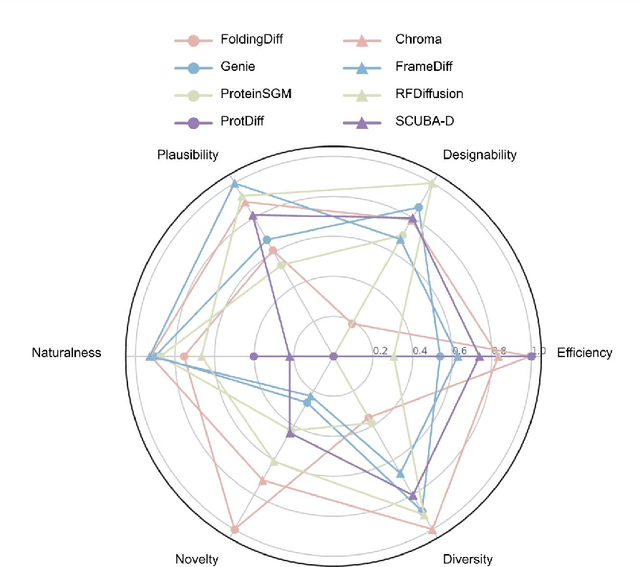
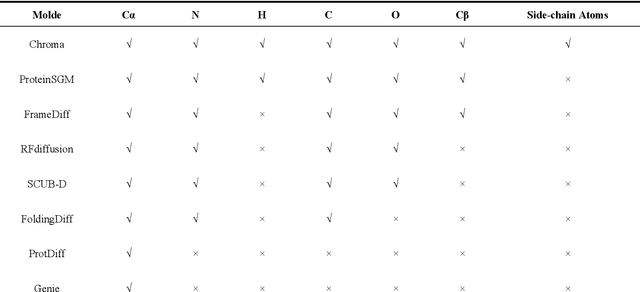
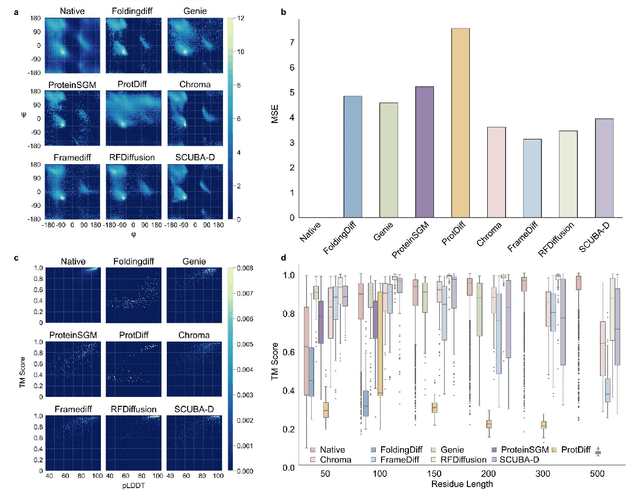
The de novo design of proteins refers to creating proteins with specific structures and functions that do not naturally exist. In recent years, the accumulation of high-quality protein structure and sequence data and technological advancements have paved the way for the successful application of generative artificial intelligence (AI) models in protein design. These models have surpassed traditional approaches that rely on fragments and bioinformatics. They have significantly enhanced the success rate of de novo protein design, and reduced experimental costs, leading to breakthroughs in the field. Among various generative AI models, diffusion models have yielded the most promising results in protein design. In the past two to three years, more than ten protein design models based on diffusion models have emerged. Among them, the representative model, RFDiffusion, has demonstrated success rates in 25 protein design tasks that far exceed those of traditional methods, and other AI-based approaches like RFjoint and hallucination. This review will systematically examine the application of diffusion models in generating protein backbones and sequences. We will explore the strengths and limitations of different models, summarize successful cases of protein design using diffusion models, and discuss future development directions.
Personalized Text-to-Image Generation with Auto-Regressive Models
Apr 17, 2025Personalized image synthesis has emerged as a pivotal application in text-to-image generation, enabling the creation of images featuring specific subjects in diverse contexts. While diffusion models have dominated this domain, auto-regressive models, with their unified architecture for text and image modeling, remain underexplored for personalized image generation. This paper investigates the potential of optimizing auto-regressive models for personalized image synthesis, leveraging their inherent multimodal capabilities to perform this task. We propose a two-stage training strategy that combines optimization of text embeddings and fine-tuning of transformer layers. Our experiments on the auto-regressive model demonstrate that this method achieves comparable subject fidelity and prompt following to the leading diffusion-based personalization methods. The results highlight the effectiveness of auto-regressive models in personalized image generation, offering a new direction for future research in this area.